111. Minimum Depth of Binary Tree Easy
Given a binary tree, find its minimum depth.
The minimum depth is the number of nodes along the shortest path from the root node down to the nearest leaf node.
Note: A leaf is a node with no children.
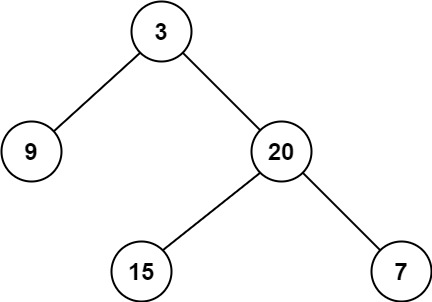
Example 1:
Input: root = [3,9,20,null,null,15,7]
Output: 2
Example 2:
Input: root = [2,null,3,null,4,null,5,null,6]
Output: 5
Approach
Input: The root node of a binary tree root.
Output: Return the minimum depth
This problem belongs to Breadth-First Search (BFS) problems.
Initialization:
- If
rootis empty, return 0 (an empty tree has a depth of 0) - Initialize the queue
queue = [(root, 1)], which stores the node and its corresponding current depth
BFS Traversal:
- Remove a node
nodeand itsdepthfrom the queue each time - If
nodeis a leaf node (has no left or right children), immediately return the current depthdepth - Otherwise, push its left and right children (if they exist) to the queue, with depth incremented by one
Implementation
python
class Solution:
    def minDepth(self, root: Optional[TreeNode]) -> int:
        # If the root is empty, the tree is empty and min depth is 0
        if not root:
            return 0

        # Use BFS (Breadth First Search) queue, initialize with root and current depth 1
        queue = [(root, 1)]

        # Start traversing the binary tree level by level
        while queue:
            node, depth = queue.pop(0)  # Extract the current node and its depth

            # If the current node is a leaf (no left or right child), it's the shortest path
            if not node.left and not node.right:
                return depth  # Return current depth as min depth

            # If the left child exists, append to queue, depth +1
            if node.left:
                queue.append((node.left, depth + 1))

            # If the right child exists, append to queue, depth +1
            if node.right:
                queue.append((node.right, depth + 1))
javascript
const minDepth = function(root) {
    // If the root node is empty, it means the tree is empty, and the min depth is 0
    if (!root) return 0;

    // Use a BFS queue, initialized with the root node and depth 1
    const queue = [[root, 1]];

    // Start level-by-level traversal of the binary tree
    while (queue.length) {
        // Remove the top node and its depth
        const [node, depth] = queue.shift();

        // If the current node is a leaf node (has no left/right children), we found the shortest path
        if (!node.left && !node.right)
            return depth;

        // If left child exists, push to queue, depth + 1
        if (node.left)
            queue.push([node.left, depth + 1])

        // If right child exists, push to queue, depth + 1
        if (node.right)
            queue.push([node.right, depth + 1])
    }
};
Complexity Analysis
- Time Complexity:
O(n) - Space Complexity:
O(h)for the queue