814. Binary Tree Pruning Medium
Given the root of a binary tree, additionally, every node's value is either a 0 or a 1.
Return the same tree where every subtree (of the given tree) not containing a 1 has been removed.
A subtree of a node node is node plus every node that is a descendant of node.
Example 1:
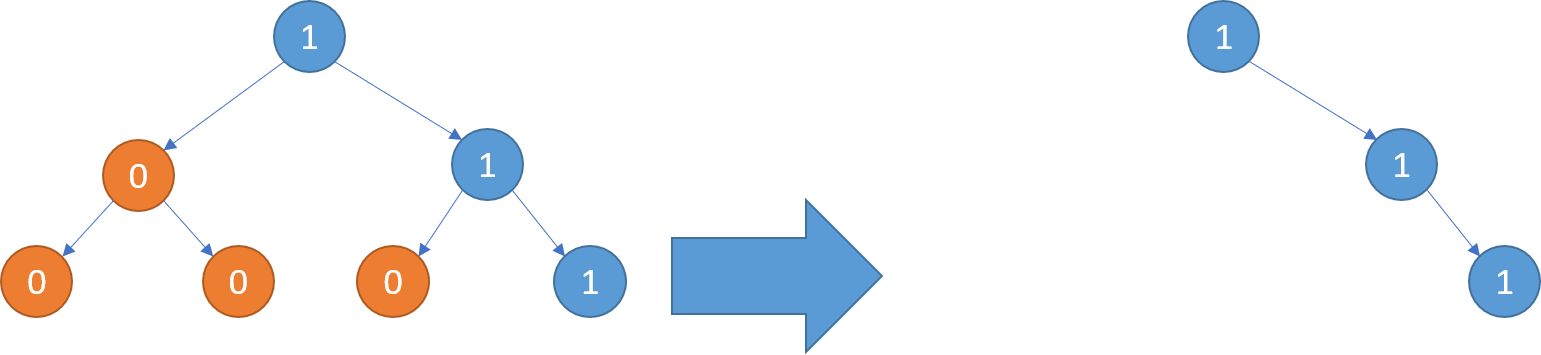
Input: root = [1,null,0,0,1] Output: [1,null,0,null,1] Explanation: Only the red nodes satisfy the property "every subtree not containing a 1". The diagram on the right represents the returned answer.

Example 2:
Input: root = [1,0,1,0,0,0,1]
Output: [1,null,1,null,1]
Example 3:
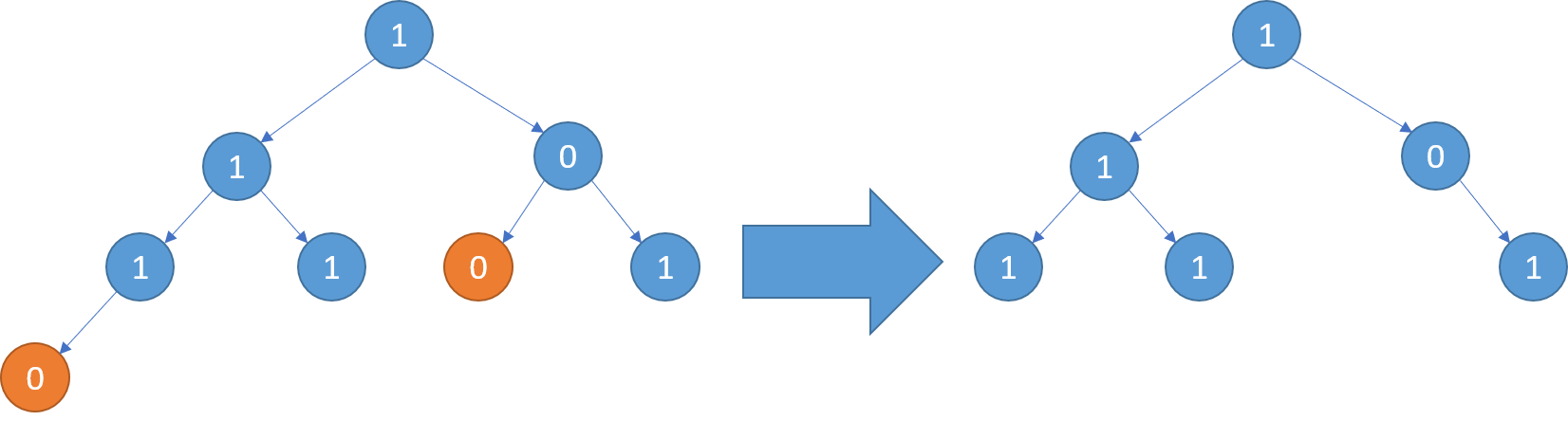
Input: root = [1,1,0,1,1,0,1,0]
Output: [1,1,0,1,1,null,1]
Approach
Input: The root node of a binary tree root.
Output: Return the same binary tree after removing all subtrees not containing a 1.
This problem belongs to Bottom-up DFS + Pruning problems.
We can break the problem down into 4 sub-problems:
- If the current node doesn't exist, it means we should prune
return None. - Recursively check if the current left node exists and contains 1. If it doesn't satisfy this, prune
return None. - Recursively check if the current right node exists and contains 1. If it doesn't satisfy this, prune
return None. - If both the left and right child nodes return
None, we need to check if the current node's value is 1. If it isn't 1, we must also prunereturn None.
Therefore, the condition for pruning the current node is: determine if the current node is 0 and neither of its child subtrees contain a 1.
Implementation
class Solution:
    def pruneTree(self, root: Optional[TreeNode]) -> Optional[TreeNode]:
        def dfs(node):
            if not node:
                return None  # Empty node, prune directly

            # Recursively process left and right subtrees, returning the pruned subtrees
            node.left = dfs(node.left)
            node.right = dfs(node.right)

            # If the current node's value is 0 and both left and right subtrees are empty, it means the whole subtree has no 1, and should be pruned
            if node.val == 0 and not node.left and not node.right:
                return None

            # Otherwise, keep the current node
            return node

return dfs(root)/*
* @param {TreeNode} root
* @return {TreeNode}
*/
var pruneTree = function(root) {
function dfs(node) {
if (!node) return null;
node.left = dfs(node.left)
node.right = dfs(node.right)
if (node.val === 0 && !node.left && !node.right)
return null;
return node;
}
return dfs(root);
};Complexity Analysis
- Time Complexity:
O(n) - Space Complexity:
O(h), wherehis the height of the tree