1457. Pseudo-Palindromic Paths in a Binary Tree Medium
Given a binary tree where node values are digits from 1 to 9. A path in the binary tree is said to be pseudo-palindromic if at least one permutation of the node values in the path is a palindrome.
Return the number of pseudo-palindromic paths going from the root node to leaf nodes.
Example 1:
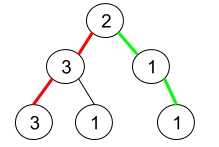
Input: root = [2,3,1,3,1,null,1]
Output: 2
Explanation: The figure above represents the given binary tree. There are three paths going from the root node to leaf nodes: the red path [2,3,3], the green path [2,1,1], and the path [2,3,1]. Among these paths only red path and green path are pseudo-palindromic paths since the red path [2,3,3] can be rearranged in [3,2,3] (palindrome) and the green path [2,1,1] can be rearranged in [1,2,1] (palindrome).
Example 2:
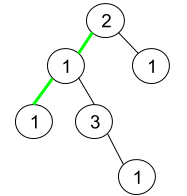
Input: root = [2,1,1,1,3,null,null,null,null,null,1]
Output: 1
Explanation: The figure above represents the given binary tree. There are three paths going from the root node to leaf nodes: the green path [2,1,1], the path [2,1,3,1], and the path [2,1]. Among these paths only the green path is pseudo-palindromic since [2,1,1] can be rearranged in [1,2,1] (palindrome).
Example 3:
Input: root = [9]
Output: 1
Approach
Input: The root node of a binary tree root, where values are from 1 to 9.
Output: Return the number of "pseudo-palindromic" paths in this tree.
This problem belongs to Top-down DFS problems.
The key to this problem is to determine the "pseudo-palindrome". To satisfy a palindromic path, we need to ensure that the collection of values has at most one odd count.
We can traverse the binary tree top-down to record the paths, which can be done with an array or a set.
Here we can use a set to determine if the current value has already appeared once. If it has appeared, we remove it, if it's not in the set, we add it in.
When visiting a leaf node, evaluate len(set) <= 1. If the condition is met, it's a pseudo-palindromic path, and we return 1, otherwise return 0.
Implementation
class Solution:
    def pseudoPalindromicPaths(self, root: Optional[TreeNode]) -> int:
        def dfs(node, odd_set):
            if not node:
                return 0

            # If the current node value is already in the set, it means it has appeared once (now an even number of times), remove it
            # Otherwise, add it to the set, representing an odd number of times
            if node.val in odd_set:
                odd_set.remove(node.val)
            else:
                odd_set.add(node.val)

            # If it's a leaf node
            if not node.left and not node.right:
                # Pseudo-palindrome condition: at most one number appeared an odd number of times
                return 1 if len(odd_set) <= 1 else 0

            # Note: to prevent left and right from sharing the same set, we must create a copy
            left_count = dfs(node.left, set(odd_set))
            right_count = dfs(node.right, set(odd_set))

            return left_count + right_count

        # Initially pass an empty set, representing no numbers on the current path
return dfs(root, set())/**
* @param {TreeNode} root
* @return {number}
*/
var pseudoPalindromicPaths = function(root) {
function dfs(node, oddSet) {
if (!node) return 0;
if (oddSet.has(node.val)) {
oddSet.delete(node.val);
} else {
oddSet.add(node.val);
}
if (!node.left && !node.right) {
return oddSet.size <= 1 ? 1 : 0;
}
const left = dfs(node.left, new Set(oddSet));
const right = dfs(node.right, new Set(oddSet));
return left + right;
}
return dfs(root, new Set());
};Complexity Analysis
- Time Complexity:
O(n) - Space Complexity:
O(h), wherehis the height of the tree.O(9 * h)because each set has at most 9 elements.