872. Leaf-Similar Trees Easy
Consider all the leaves of a binary tree, from left to right order, the values of those leaves form a leaf value sequence.
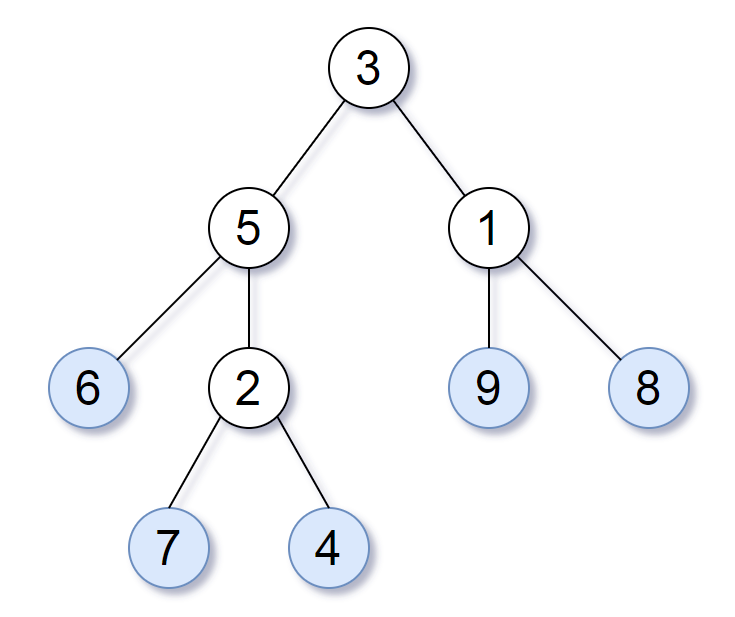
For example, in the given tree above, the leaf value sequence is (6, 7, 4, 9, 8).
Two binary trees are considered leaf-similar if their leaf value sequence is the same.
Return true if and only if the two given trees with head nodes root1 and root2 are leaf-similar.
Example 1:
Input: root1 = [3,5,1,6,2,9,8,null,null,7,4], root2 = [3,5,1,6,7,4,2,null,null,null,null,null,null,9,8]
Output: true
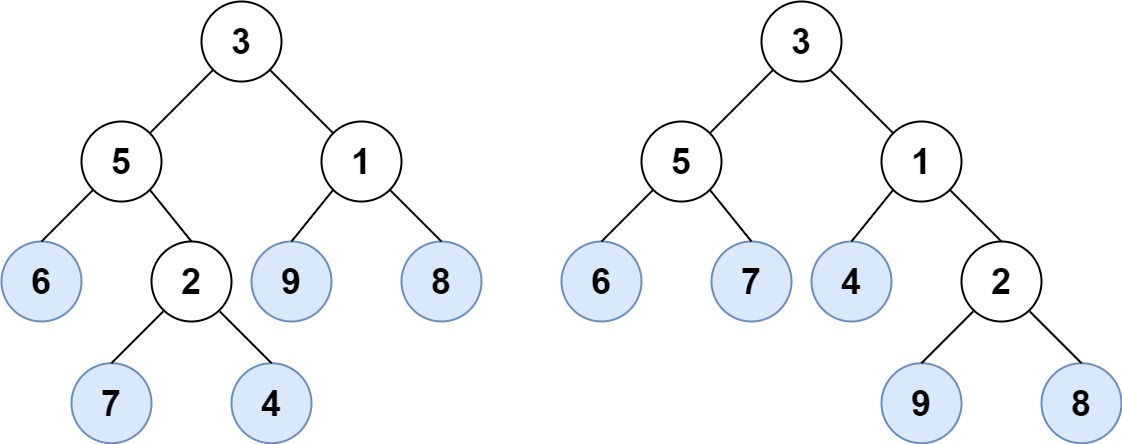
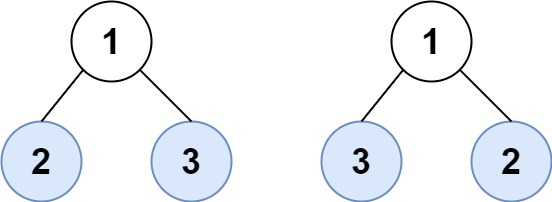
Example 2:
Input: root1 = [1,2,3], root2 = [1,3,2]
Output: false
Approach
Input: The root nodes of two binary trees root1 and root2.
Output: Determine whether the leaf nodes of these two trees are similar
This problem belongs to Binary Tree Traversal problems.
We can define a recursive depth-first traversal function dfs. During the traversal process, we determine if a node is a leaf node and record it down. Finally we judge whether the two trees' leaf sequences are similar.
The key point is the logic for identifying a leaf node: if not node.left and not node.right.
Implementation
class Solution:
    def leafSimilar(self, root1: Optional[TreeNode], root2: Optional[TreeNode]) -> bool:
        # Used to store the leaf node sequences of the two trees
        leaves1 = []
        leaves2 = []

        # Define DFS function to collect leaf nodes
        def dfs(node, leaves):
            if not node:
                return
            # If the current node is a leaf node, add it to the sequence
            if not node.left and not node.right:
                leaves.append(node.val)
            # Recursively traverse the left subtree
            dfs(node.left, leaves)
            # Recursively traverse the right subtree
            dfs(node.right, leaves)

        # Get the leaf node sequences for both trees
        dfs(root1, leaves1)
        dfs(root2, leaves2)

        # Compare if the two sequences are identical
return leaves1 == leaves2/**
* @param {TreeNode} root1
* @param {TreeNode} root2
* @return {boolean}
*/
var leafSimilar = function(root1, root2) {
const leaves1 = [];
const leaves2 = [];
function dfs(node, leaves) {
if (!node) return;
if (!node.left && !node.right) {
leaves.push(node.val);
}
dfs(node.left, leaves);
dfs(node.right, leaves);
}
dfs(root1, leaves1);
dfs(root2, leaves2);
if (leaves1.length !== leaves2.length) return false;
for (let i = 0; i < leaves1.length; i++) {
if (leaves1[i] !== leaves2[i]) return false;
}
return true;
};Complexity Analysis
- Time Complexity:
O(n) - Space Complexity:
O(h), wherehis the height of the tree