965. Univalued Binary Tree Easy
A binary tree is univalued if every node in the tree has the same value.
Return true if and only if the given tree is univalued.
Example 1:
Input: [1,1,1,1,1,null,1] Output: true
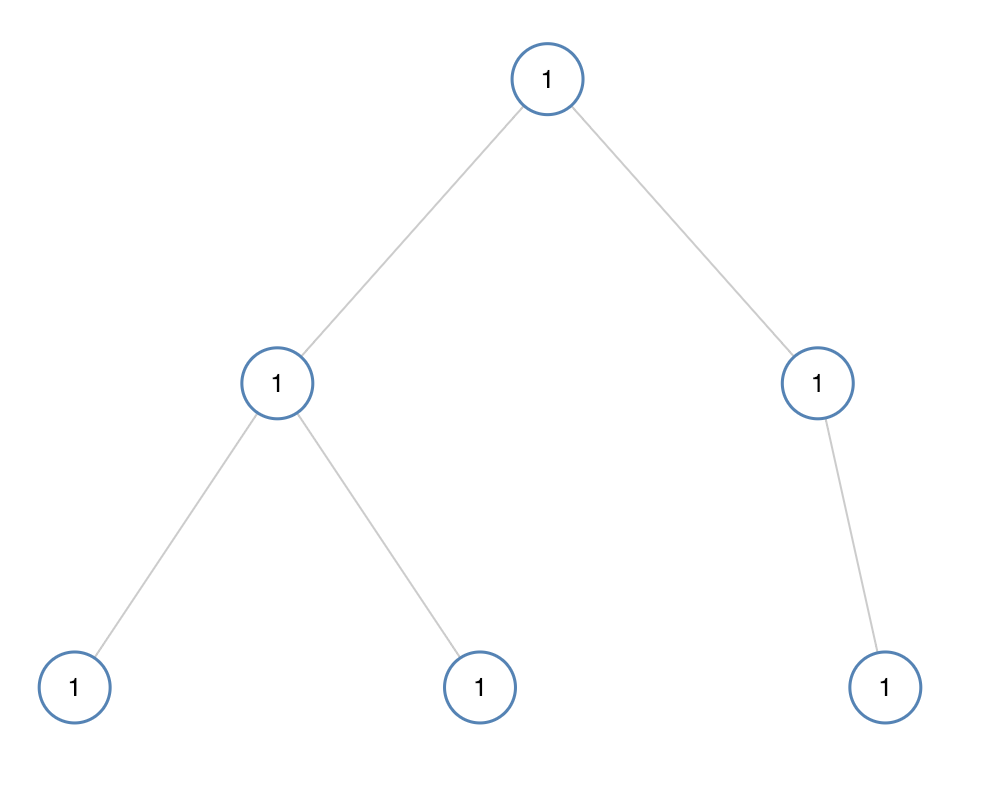
Example 2:
Input: [2,2,2,5,2]
Output: false
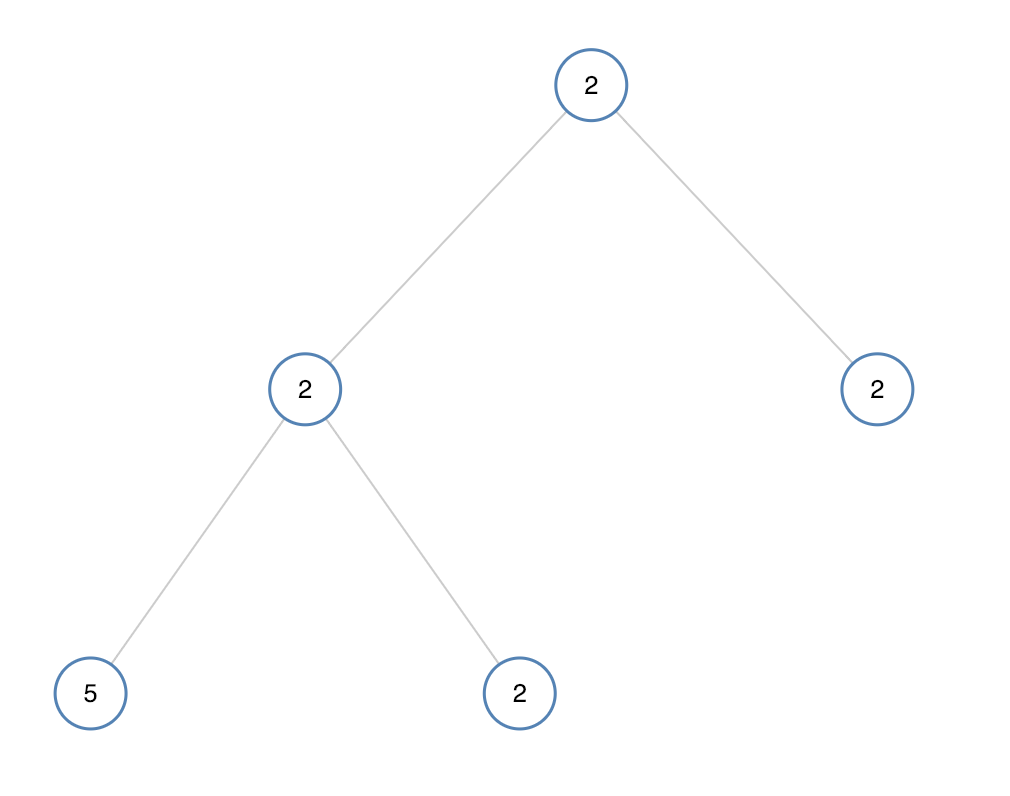
Approach
Input: The root node of a binary tree root.
Output: Determine if all values in the tree are the same, meaning it is a univalued binary tree
This problem can be solved by using either Top-down DFS or Bottom-up DFS.
Bottom-up DFS
The characteristic of Bottom-up DFS is to recurse down to the leaf nodes first, then return level by level, processing information, with each level relying on its child nodes' returned results to compute the current node's result.
So we can think when reaching the last subtree, we only need to compare whether the node is different from its left and right child nodes.
When it's different from the left node, it returns False. The same logic applies to comparing with the right node.
If there is no left or right node, there is no need to compare, because having only one value is definitely True.
Then recursively evaluate if both left and right subtrees return True.
Top-down DFS
In the Top-down DFS approach, we can pass the current node down to the child nodes for comparison. As soon as a child node is found inconsistent with the parent node, we return False.
Then recursively evaluate if the left subtree and the right subtree both return True.
The biggest difference from bottom-up is whether parameters need to be passed down. Top-down requires comparing the current node to the parent node, while bottom-up involves comparing the current node to its children.
Implementation
Bottom-up DFS
# Bottom-up approach
class Solution:
    def isUnivalTree(self, root: Optional[TreeNode]) -> bool:
        def dfs(node):
            # An empty node is by default a univalued tree
            if not node:
                return True

            # If the left child exists and its value is different, return False
            if node.left and node.left.val != node.val:
                return False

            # If the right child exists and its value is different, return False
            if node.right and node.right.val != node.val:
                return False

            # Recursively evaluate if the left and right subtrees are univalued
            return dfs(node.left) and dfs(node.right)

return dfs(root)/**
* @param {TreeNode} root
* @return {boolean}
*/
var isUnivalTree = function(root) {
function dfs(node) {
if (!node) return true;
if (node.left && node.val !== node.left.val)
return false;
if (node.right && node.val !== node.right.val)
return false;
return dfs(node.left) && dfs(node.right);
}
return dfs(root);
};Top-down DFS
# Top-down approach
def isUnivalTree(self, root: Optional[TreeNode]) -> bool:
    # If the tree is empty, return True directly, as an empty tree meets the definition
    if not root:
        return True

    # DFS to check if node values are the same as their parent
    def dfs(node: Optional[TreeNode], parentVal: int) -> bool:
        # If node is empty, return True (Base case)
        if not node:
            return True

        # If current node value differs from the parent's value, return False
        if node.val != parentVal:
            return False

        # Recursively check the left and right subtrees, passing the current node's value as the parent value
        left = dfs(node.left, node.val)
        right = dfs(node.right, node.val)

        # Return True if both left and right subtrees return True, otherwise False
        return left and right

    # Start from the root node, passing its value as the initial parent value
return dfs(root, root.val)/**
* @param {TreeNode} root
* @return {boolean}
*/
var isUnivalTree = function(root) {
function dfs(node, parentVal) {
if (!node) return true;
if (node.val !== parentVal)
return false
return dfs(node.left, node.val) && dfs(node.right, node.val);
}
return dfs(root, root.val);
};Complexity Analysis
- Time Complexity:
O(n) - Space Complexity:
O(h), wherehis the height of the tree