112. Path Sum Easy
Given the root of a binary tree and an integer targetSum, return true if the tree has a root-to-leaf path such that adding up all the values along the path equals targetSum.
A leaf is a node with no children.
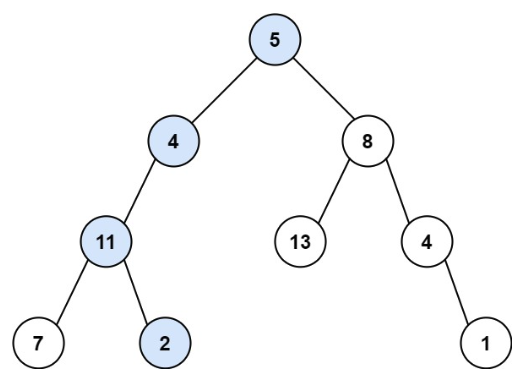
Example 1:
Input: root = [5,4,8,11,null,13,4,7,2,null,null,null,1], targetSum = 22
Output: true
Explanation: The root-to-leaf path with the target sum is shown.
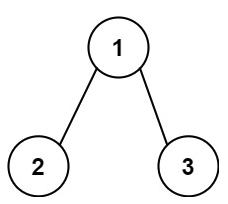
Example 2:
Input: root = [1,2,3], targetSum = 5
Output: false
Explanation: There two root-to-leaf paths in the tree:
(1 --> 2): The sum is 3.
(1 --> 3): The sum is 4.
There is no root-to-leaf path with sum = 5.
Approach
Input: The root node of a binary tree root, and an integer targetSum, representing the target path sum.
Output: Determine if there is a path from the root node to a leaf node such that the sum of the node values along the path exactly equals targetSum.
This problem belongs to Top-down DFS + Subtraction Accumulation problems.
We start traversing from the root node, and during each recursion, subtract the current node's value from targetSum, which represents "how much of the target sum has been consumed by this path so far".
- If the current node is a leaf node, then check if the current node's value equals the remaining
targetSum; - Otherwise, recursively check the left and right subtrees; as long as one path satisfies the condition, return
True.
Essentially, the key to this problem is: continuously subtracting the node values from the target sum along the path until checking if it's exactly 0 at the leaf node.
Implementation
class Solution:
    def hasPathSum(self, root: Optional[TreeNode], targetSum: int) -> bool:
        # If the current node is null, directly return False
        if not root:
            return False

        # If the current node is a leaf node, check if the path sum exactly equals targetSum
        if not root.left and not root.right:
            return root.val == targetSum

        # Otherwise, recursively check the left and right subtrees, update target as targetSum - current node value
        new_target = targetSum - root.val

        return (
            self.hasPathSum(root.left, new_target) or
            self.hasPathSum(root.right, new_target)
)/**
* @param {TreeNode} root
* @param {number} targetSum
* @return {boolean}
*/
var hasPathSum = function(root, targetSum) {
// If the current node is null, directly return False
if (!root) return false;
// If the current node is a leaf node, check if the path sum exactly equals targetSum
if (!root.left && !root.right) {
return root.val == targetSum;
}
// Otherwise, recursively check left and right subtrees, update target as targetSum - current node value
targetSum -= root.val;
return hasPathSum(root.left, targetSum) || hasPathSum(root.right, targetSum)
};Complexity Analysis
- Time Complexity:
O(n) - Space Complexity:
O(h)