236. Lowest Common Ancestor of a Binary Tree Medium
Given a binary tree, find the lowest common ancestor (LCA) of two given nodes in the tree.
According to the definition of LCA on Wikipedia: "The lowest common ancestor is defined between two nodes p and q as the lowest node in T that has both p and q as descendants (where we allow a node to be a descendant of itself)."
Example 1:
Input: root = [3,5,1,6,2,0,8,null,null,7,4], p = 5, q = 1
Output: 3
Explanation: The LCA of nodes 5 and 1 is 3.
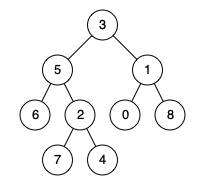
Example 2:
Input: root = [3,5,1,6,2,0,8,null,null,7,4], p = 5, q = 4
Output: 5
Explanation: The LCA of nodes 5 and 4 is 5, since a node can be a descendant of itself according to the LCA definition.
Example 3:
Input: root = [1,2], p = 1, q = 2
Output: 1
Approach
Input: The root node of a binary tree root, and two specified nodes p and q
Output: Return the lowest common ancestor of these two nodes
This problem is suitable to be solved using Bottom-up DFS.
We can summarize the following 3 cases:
- If
pandqrespectively lie in the left and right subtrees of the current node, then the current node is the lowest common ancestor. - If
pandqboth lie in the left subtree, then the lowest common ancestor is the node first found in the left subtree. - If
pandqboth lie in the right subtree, then the lowest common ancestor is the node first found in the right subtree.
Therefore, we traverse the nodes through DFS, looking for p or q. Once either node is found, we return it, and then determine the lowest common ancestor based on the return values from the left and right subtrees, passing it upwards.
Case Breakdown
│
├── Current node is empty
│   └── Return empty node (None)
│
├── Current node is p
│   └── Return current node (p)
│
├── Current node is q
│   └── Return current node (q)
│
└── Other cases (recurse left and right subtrees)
    │
    ├── Both left and right subtrees found something
    │   └── Return current node (the Lowest Common Ancestor)
    │
    ├── Only the left subtree found something
    │   └── Return left subtree's result
    │
    ├── Only the right subtree found something
    │   └── Return right subtree's result
    │
    └── Neither subtree found something
        └── Return empty node (None)
Implementation
class Solution:
    def lowestCommonAncestor(self, root: 'TreeNode', p: 'TreeNode', q: 'TreeNode') -> 'TreeNode':
        """
        Find the Lowest Common Ancestor (LCA) of two nodes in a binary tree
        Approach: Postorder traversal (Bottom-up), recursively process left and right subtrees first, then handle the current node
        """
        # If the current node is null, or if it is exactly p or q, immediately return the current node
        if root is None or root == p or root == q:
            return root

        # Look for the LCA of p and q in the left subtree
        left = self.lowestCommonAncestor(root.left, p, q)
        # Look for the LCA of p and q in the right subtree
        right = self.lowestCommonAncestor(root.right, p, q)

        # If both left and right subtrees found p or q, it means the current node is the LCA
        if left and right:
            return root

        # If found in the left subtree, return left subtree's result
        if left:
            return left

        # If found in the right subtree, return right subtree's result
return right/**
* @param {TreeNode} root
* @param {TreeNode} p
* @param {TreeNode} q
* @return {TreeNode}
*/
var lowestCommonAncestor = function(root, p, q) {
if (!root || root == p || root == q) return root;
const left = lowestCommonAncestor(root.left, p, q);
const right = lowestCommonAncestor(root.right, p, q);
if (left && right) return root;
if (left) return left;
return right;
};Complexity Analysis
- Time Complexity:
O(n) - Space Complexity:
O(h)