203. Remove Linked List Elements Easy
Given the head of a linked list and an integer val, remove all the nodes of the linked list that has Node.val == val, and return the new head.
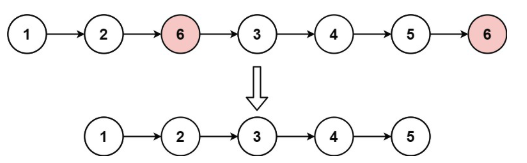
Example 1:
Input: head = [1,2,6,3,4,5,6], val = 6
Output: [1,2,3,4,5]
Example 2:
Input: head = [], val = 1
Output: []
Example 3:
Input: head = [7,7,7,7], val = 7
Output: []
Approach
Input: A linked list head, an integer val
Output: Remove all nodes in the linked list with value equal to val, and return the new head
This problem belongs to the Linked List Deletion category. The key is in handling node deletion, especially taking care of the case where the head node might also be deleted.
To simplify the operation, we introduce a sentinel node dummy and point it to the head of the original linked list (dummy.next = head). In this way, regardless of whether the head node is deleted or not, the operational logic can be consistently unified and processed without special branch checks.
Then, we use two pointers:
currpoints to the currently traversed node (starting fromhead).prevpoints to the predecessor node ofcurr(initiallydummy).
During the traversal:
- If
curr.val == val, we pointprev.nexttocurr.next, skipping the node in the linked list. - Otherwise, it means the current node is retained, so update
prev = curr. - In any case,
currmoves forward in each round.
Finally, return dummy.next as the new linked list head, since the original head might have been deleted.
Implementation
class Solution:
    def removeElements(self, head: Optional[ListNode], val: int) -> Optional[ListNode]:
        # Create a dummy sentinel node, with next pointing to the original linked list head
        dummy = ListNode(next=head)

        # prev is the node before the current node, curr is the current node being traversed
        prev = dummy
        curr = head

        # Traverse the entire linked list
        while curr:
            if curr.val == val:
                # The current node's value equals the target value, delete: prev skips curr
                prev.next = curr.next
            else:
                # Otherwise keep the current node, move prev forward
                prev = curr

            # curr always moves forward
            curr = curr.next

        # Return the linked list head after removing the target value nodes (the node after dummy)
return dummy.next/**
* @param {ListNode} head
* @param {number} val
* @return {ListNode}
*/
const removeElements = function(head, val) {
// Create a dummy sentinel node, with next pointing to the original linked list head
const dummy = new ListNode(null, head);
// prev is the node before the current node, curr is the currently traversed node
let prev = dummy;
let curr = head;
// Traverse the entire linked list
while (curr != null) {
if (curr.val == val) {
// Re-route passing pointer over the node to be deleted
prev.next = curr.next;
} else {
// Otherwise retain the current node, move prev forwards
prev = curr;
}
// curr always moves forwards
curr = curr.next;
}
return dummy.next;
};Complexity Analysis
- Time Complexity:
O(n) - Space Complexity:
O(1)