951. Flip Equivalent Binary Trees Medium
For a binary tree T, we can define a flip operation as follows: choose any node, and swap the left and right child subtrees.
A binary tree X is flip equivalent to a binary tree Y if and only if we can make X equal to Y after some number of flip operations.
Given the roots of two binary trees root1 and root2, return true if the two trees are flip equivalent or false otherwise.
Example 1:
Input: root1 = [1,2,3,4,5,6,null,null,null,7,8], root2 = [1,3,2,null,6,4,5,null,null,null,null,8,7]
Output: true
Explanation: We flipped at nodes with values 1, 3, and 5.
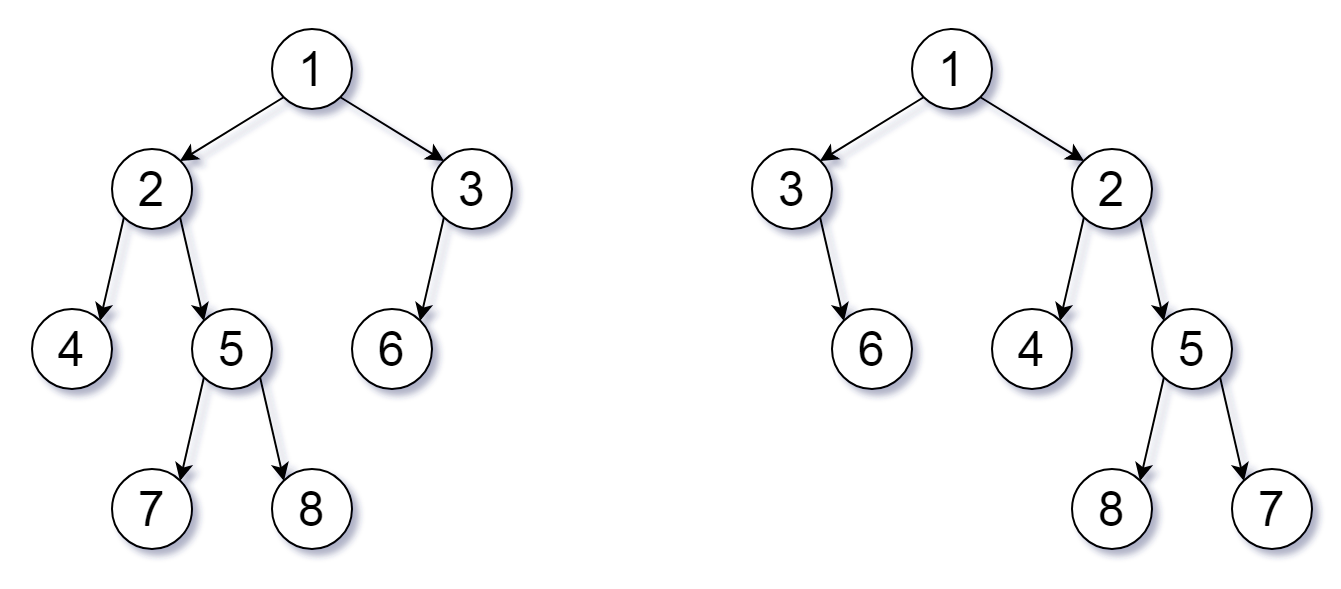
Example 2:
Input: root1 = [], root2 = []
Output: true
Example 3:
Input: root1 = [], root2 = [1]
Output: false
Approach
Input: The root nodes of two binary trees root1 and root2.
Output: Determine if the two binary trees can be equivalent through flipping.
This problem can be solved using Bottom-up DFS.
- The key to this problem is that it is not mandatory to flip every subtree.
- As long as you can get the same tree without flipping, you don't have to flip.
- Flip only if flipping results in the same tree.
- So you have to compare both the unflipped result and the flipped result.
- Meeting either one of them is enough.
We can recursively traverse and compare whether these two trees are equal when flipped and not flipped to get the answer.
Implementation
class Solution:
    def flipEquiv(self, root1: Optional[TreeNode], root2: Optional[TreeNode]) -> bool:
        def dfs(node1, node2):
            # If both nodes are null, structural match, return True
            if not node1 and not node2:
                return True

            # If one is null and the other isn't, or values are different, they are not equivalent
            if not node1 or not node2 or node1.val != node2.val:
                return False

            # Case 1: No flip, left and right subtrees match respectively
            no_flip = dfs(node1.left, node2.left) and dfs(node1.right, node2.right)

            # Case 2: Left and right subtrees match after flipping
            flip = dfs(node1.left, node2.right) and dfs(node1.right, node2.left)

            # Return true if either case is satisfied
            return no_flip or flip

return dfs(root1, root2)/**
* @param {TreeNode} root1
* @param {TreeNode} root2
* @return {boolean}
*/
var flipEquiv = function(root1, root2) {
function dfs(node1, node2) {
if (node1 == null && node2 == null)
return true;
if (node1 == null || node2 == null || node1.val !== node2.val)
return false;
const noFlip = dfs(node1.left, node2.left) && dfs(node1.right, node2.right)
const flip = dfs(node1.left, node2.right) && dfs(node1.right, node2.left)
return noFlip || flip
}
return dfs(root1, root2)
};Complexity Analysis
- Time Complexity:
O(n) - Space Complexity:
O(h), wherehis the height of the tree