2. Add Two Numbers Medium
You are given two non-empty linked lists representing two non-negative integers. The digits are stored in reverse order, and each of their nodes contains a single digit. Add the two numbers and return the sum as a linked list.
You may assume the two numbers do not contain any leading zero, except the number 0 itself.
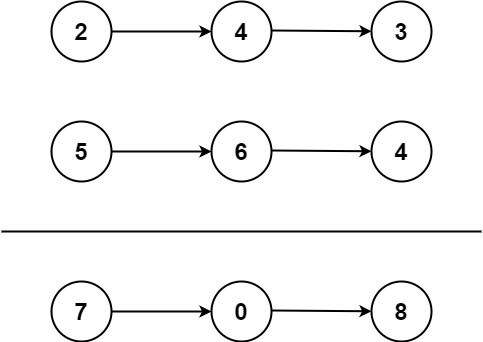
Example 1:
Input: l1 = [2,4,3], l2 = [5,6,4]
Output: [7,0,8]
Explanation: 342 + 465 = 807.
Example 2:
Input: l1 = [0], l2 = [0]
Output: [0]
Example 3:
Input: l1 = [9,9,9,9,9,9,9], l2 = [9,9,9,9]
Output: [8,9,9,9,0,0,0,1]
Approach
Input: Two linked lists l1 and l2, each node storing a single digit
Output: Return a new linked list representing their sum
This problem belongs to the Merge Linked List category.
- We need a variable
carryto store the carry-over value from addition. Since the maximum single digit is 9,carrywill only be 0 or 1. - Create a virtual head node
dummy: its.nextpoints to the final answer linked list. - Traverse both linked lists
l1andl2until both are empty and thecarryis also 0:while l1 or l2 or carry: - Extract the values of the current digits
val1,val2. - Calculate the total sum:
total = val1 + val2 + carry. - The current node value is:
nodeVal = total % 10. - Update the carry value:
carry = total // 10. - Insert the current digit result into the result linked list:
curr.next = ListNode(nodeVal).
Finally, return dummy.next, which is the head of the result linked list.
Implementation
class Solution:
    def addTwoNumbers(self, l1: Optional[ListNode], l2: Optional[ListNode]) -> Optional[ListNode]:
        # Create a dummy node to facilitate subsequent operations
        dummy = ListNode(0)
        curr = dummy  # Pointer used to build the result linked list
        carry = 0     # Carry cache

        # Traverse both linked lists until both are empty and there is no carry
        while l1 or l2 or carry:
            # Extract the values of the two nodes respectively, treating them as 0 if empty
            val1 = l1.val if l1 else 0
            val2 = l2.val if l2 else 0

            # Sum of the two values plus carry
            total = val1 + val2 + carry
            carry = total // 10     # Update carry (0 or 1)
            node_val = total % 10   # Value of the current digit

            # Build a new node, add it to the result linked list
            curr.next = ListNode(node_val)
            curr = curr.next  # Move pointer forward

            # Move the pointers of the two input linked lists
            if l1:
                l1 = l1.next
            if l2:
                l2 = l2.next

        # Return the next node of the dummy node, which is the head of the result linked list
return dummy.next/**
* @param {ListNode} l1
* @param {ListNode} l2
* @return {ListNode}
*/
var addTwoNumbers = function(l1, l2) {
const dummy = new ListNode(0);
let curr = dummy;
let carry = 0;
while (l1 || l2 || carry) {
const val1 = l1 ? l1.val : 0;
const val2 = l2 ? l2.val : 0;
const total = val1 + val2 + carry;
const nodeVal = total % 10;
carry = Math.floor(total / 10);
curr.next = new ListNode(nodeVal);
curr = curr.next;
if (l1) {
l1 = l1.next;
}
if (l2) {
l2 = l2.next;
}
}
return dummy.next;
};Complexity Analysis
- Time Complexity:
O(max(m, n)) - Space Complexity:
O(1)(excluding the returned list)