1290. Convert Binary Number in a Linked List to Integer Easy
Given head which is a reference node to a singly-linked list. The value of each node in the linked list is either 0 or 1. The linked list holds the binary representation of a number.
Return the decimal value of the number in the linked list.
The most significant bit is at the head of the linked list.
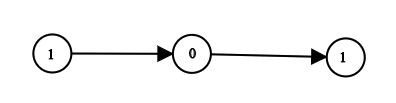
Example 1:
Input: head = [1,0,1]
Output: 5
Explanation: (101) in base 2 = (5) in base 10
Example 2:
Input: head = [0]
Output: 0
Example 3:
Input: head = [1]
Output: 1
Example 4:
Input: head = [1,0,0,1,0,0,1,1,1,0,0,0,0,0,0]
Output: 18880
Example 5:
Input: head = [0,0]
Output: 0
Approach
Input: A linked list head representing a binary number, where each node's value is 0 or 1
Output: Return the decimal integer corresponding to the binary number represented by the linked list
This problem belongs to the Linked List Traversal category. We need to sequentially read the value of each node from left to right, and convert it to decimal according to binary rules.
Method 1: Construct integer using bitwise operations (Recommended)
- Use a variable
resultto record the current result. Every time a node is traversed, shiftresultleft by one bit (i.e.result << 1, which is equivalent to multiplying by 2), and add the current node's value (i.e.curr.val). - The complete operation is:
result = (result << 1) | curr.val. - When the traversal is completed,
resultis the final decimal value.
This method does not require extra space. The time complexity is O(n), and space complexity is O(1).
Method 2: Splice a string and then convert to decimal
During traversing, we can also splice the node values into a binary string s, and then convert it into a decimal integer utilizing a method like int(s, 2) when the traversal ends.
This approach is extremely intuitive but involves string appending, making it slightly less performant than Method 1.
Implementation
class Solution:
    def getDecimalValue(self, head: Optional[ListNode]) -> int:
        result = 0  # Initialize result to 0
        curr = head

        # Traverse the list, shifting left to construct the binary representation into an integer
        while curr:
            # Left shift by one bit (equivalent to * 2), and bitwise OR the current value
            result = (result << 1) | curr.val
            curr = curr.next

return result/**
* @param {ListNode} head
* @return {number}
*/
const getDecimalValue = function(head) {
let curr = head;
let result = 0; // Initialize result to 0
// Traverse the list
while (curr != null) {
// Left shift by 1 and bitwise OR the current value
result = (result << 1) | curr.val;
curr = curr.next;
}
return result;
};Complexity Analysis
- Time Complexity:
O(n) - Space Complexity:
O(1)
Links
1290. Convert Binary Number in a Linked List to Integer (English)