1110. Delete Nodes And Return Forest Medium
Given the root of a binary tree, each node in the tree has a distinct value.
After deleting all nodes with a value in to_delete, we are left with a forest (a disjoint union of trees).
Return the roots of the trees in the remaining forest. You may return the result in any order.
Example 1:
Input: root = [1,2,3,4,5,6,7], to_delete = [3,5]
Output: [[1,2,null,4],[6],[7]]
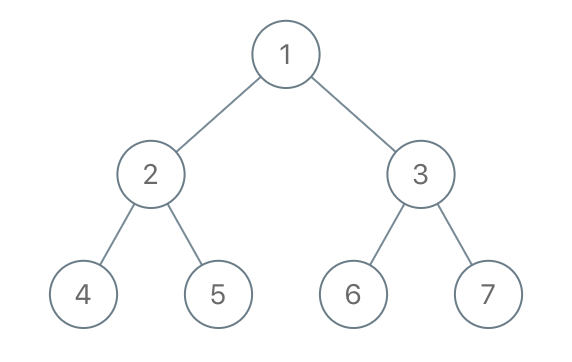
Example 2:
Input: root = [1,2,4,null,3], to_delete = [3]
Output: [[1,2,4]]
Approach
Input: The root node of a binary tree root, and a deletion list to_delete.
Output: Return a collection (forest) of trees that do not contain the deleted node values.
This problem belongs to Bottom-up DFS + Pruning problems.
The core of this problem is to recursively process the binary tree through post-order traversal (Bottom-up DFS), delete the specified nodes, and collect the root nodes of the remaining subtrees to form a forest (collection).
At the core
- Delete node: Remove the nodes in
to_deletefrom the tree and break their connection with the parent node. - Form a forest: After deleting a node, its non-empty left and right subtrees become the roots of new subtrees and are added to the result list.
Key points:
- You need to track which nodes are the root nodes of the forest (i.e. those having no parent nodes or whose parent node was deleted).
- Delete operations will change the tree structure, so be sure to process the subtrees first (postorder traversal).
- The root node requires special handling because it has no parent.
Core Logic
Postorder Traversal:
- First, recursively process the left and right subtrees, and update their structure (the result after deleting the specified nodes).
- Then process the current node, decide whether to delete it, and whether to add its subtrees to the forest.
Deletion Rules:
- If the current node's value is in
to_delete: - Add its non-empty left and right subtrees to the result list (as roots of new subtrees).
- Return
None, indicating that the current node is deleted.
If the current node is not deleted:
- Update its left and right subtree pointers (based on the recursion results).
- If it is a root node, or its parent was deleted, add it to the result list.
Root Node Handling:
- The root node has no parent, so it needs to be checked separately whether to keep it (if it's not deleted, add it to the result).
Implementation
class Solution:
    def delNodes(self, root: Optional[TreeNode], to_delete: List[int]) -> List[TreeNode]:
        result = []
        delete_set = set(to_delete)  # Convert to set for O(1) lookups

        def dfs(node):
            if not node:
                return None  # Empty node returns None, terminating current recursion

            # Recursively process left and right subtrees
            node.left = dfs(node.left)
            node.right = dfs(node.right)

            # Current node needs to be deleted
            if node.val in delete_set:
                # If there are child nodes, let their roots form a new tree in the result
                if node.left:
                    result.append(node.left)
                if node.right:
                    result.append(node.right)
                return None  # Return None to indicate this node is deleted

            # Current node is not deleted, return it normally
            return node

        # Special processing: if root node is not in deletion list, add to result forest
        if dfs(root):
            result.append(root)

return result/**
* @param {TreeNode} root
* @param {number[]} to_delete
* @return {TreeNode[]}
*/
var delNodes = function(root, to_delete) {
const ans = [];
const s = new Set(to_delete);
function dfs(node) {
if (!node) return null;
node.left = dfs(node.left);
node.right = dfs(node.right);
if (s.has(node.val)) {
if (node.left) ans.push(node.left);
if (node.right) ans.push(node.right);
return null;
}
return node;
}
if (dfs(root))
ans.push(root);
return ans;
};Complexity Analysis
- Time Complexity:
O(n) - Space Complexity:
O(n)