92. Reverse Linked List II Medium
Given the head of a singly linked list and two integers left and right where left <= right, reverse the nodes of the list from position left to position right, and return the reversed list.
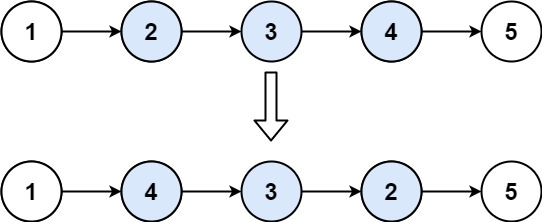
Example 1:
Input: head = [1,2,3,4,5], left = 2, right = 4
Output: [1,4,3,2,5]
Example 2:
Input: head = [5], left = 1, right = 1
Output: [5]
Approach
Input: A linked list head, two integers left and right
Output: Reverse the nodes in the range [left, right] in the linked list, and return the reversed linked list
This problem belongs to the Linked List Reversal category.
... p0 -> left ... -> right -> right + 1 ... => ... p0 -> right ... -> left -> right + 1 ...
First, we need to find the node immediately preceding the start of the reversal, prev.
Next, we reverse the nodes within [left, right]. We must record the last node before the reversal reserve_pre, and the node that comes immediately after the reversed portion.
After the reversal is complete, the traversed node curr should be at position right + 1. The node after prev becomes the last node of the reversed portion, so we need to point it to the node that originally followed the reversed portion: prev.next.next = curr.
Finally, we update prev.next to point to the new head of the reversed portion.
Implementation
class Solution:
    def reverseBetween(self, head: Optional[ListNode], left: int, right: int) -> Optional[ListNode]:
        # Create a dummy node to uniformly handle cases where the head node is reversed
        dummy = ListNode(0)
        dummy.next = head

        # Step 1: Find the node immediately before 'left' (the predecessor of the reversed section)
        prev = dummy
        for _ in range(left - 1):
            prev = prev.next  # Move to the node right before 'left'

        # Step 2: Start reversing the linked list nodes between 'left' and 'right'
        reverse_prev = None
        curr = prev.next  # Start reversing from the 'left'-th node

        for _ in range(right - left + 1):
            next_temp = curr.next
            curr.next = reverse_prev
            reverse_prev = curr
            curr = next_temp

        # Step 3: Reconnect the reversed section back into the linked list
        # prev.next points to the original 'left' node, which is now the tail of the reversed section
        # It should connect to the remainder of the list (curr)
        prev.next.next = curr
        # prev.next is updated to point to the new head of the reversed section (reverse_prev)
        prev.next = reverse_prev

return dummy.next # Return the actual head node/**
* @param {ListNode} head
* @param {number} left
* @param {number} right
* @return {ListNode}
*/
var reverseBetween = function(head, left, right) {
const dummy = new ListNode(0, head);
let p0 = dummy;
for (let i = 0; i < left - 1; i++) {
p0 = p0.next;
}
let prev = null;
let curr = p0.next;
for (let j = left; j < right + 1; j++) {
const nxt = curr.next;
curr.next = prev;
prev = curr;
curr = nxt;
}
p0.next.next = curr;
p0.next = prev;
return dummy.next;
};Complexity Analysis
- Time Complexity:
O(n) - Space Complexity:
O(1)