143. Reorder List Medium
You are given the head of a singly linked-list. The list can be represented as:
L0 → L1 → … → Ln - 1 → Ln
Reorder the list to be on the following form:
L0 → Ln → L1 → Ln - 1 → L2 → Ln - 2 → …
You may not modify the values in the list's nodes. Only nodes themselves may be changed.
Example 1:
Input: head = [1,2,3,4]
Output: [1,4,2,3]
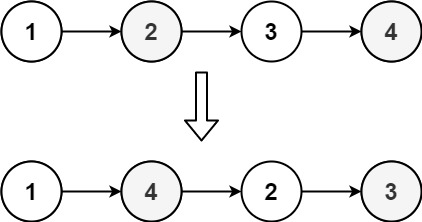
Example 2:
Input: head = [1,2,3,4,5]
Output: [1,5,2,4,3]
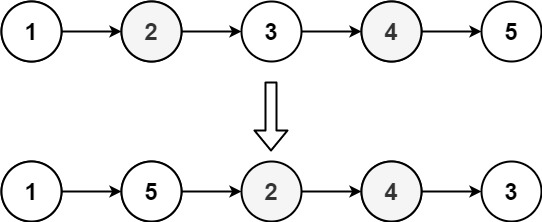
Approach
Input: A linked list head
Output: Reorder the linked list, requiring alternating arrangement of head and tail items L0 → Ln → L1 → Ln - 1 → L2 → Ln - 2 → …
This problem belongs to the Linked List Reordering category.
This problem can be solved in three steps:
- Use fast and slow pointers to find the middle point of the linked list.
- Reverse the second half of the linked list starting from the middle point.
- Alternately merge the entire linked list.
- First half:
1 → 2 → 3 - Second half reversed:
6 → 5 → 4 - Alternating merge:
1 → 6 → 2 → 5 → 3 → 4
- First half:
Implementation
python
def middleNode(head):
    slow, fast = head, head
    while fast and fast.next:
        fast = fast.next.next
        slow = slow.next
    return slow

def reverseList(head):
    pre, cur = None, head
    while cur:
        nxt = cur.next
        cur.next = pre
        pre = cur
        cur = nxt
    return pre

class Solution:
    def reorderList(self, head: Optional[ListNode]) -> None:
        # First find the middle node
        mid = middleNode(head)
        # Reversing the second half (nodes after middle node) to get a trailing head, which leads all the way backward to the middle node
        # 1(head) -> 2 -> 3 <- 4 <- 5(head2)
        head2 = reverseList(mid)
        # Loop from head2 until finding the mid node, because mid points to None after reversing
        while head2.next:
            # 1(head) -> 2 -> 3 -> 4 -> 5
            # 5(head2) -> 4 -> 3(mid)
            # Save the next node of head
            nxt = head.next
            # Save the next node of head2
            nxt2 = head2.next
            # Make head next node point to head2: 1 -> 5
            head.next = head2
            # Make head2 next node point to head.next: 5 -> 2
            head2.next = nxt
            # Move head to its original next node
            head = nxt
            # Move head2 to its original next node
            head2 = nxt2

        # ----------- Stack alternative approach ----------- #
        # curr = head
        # stack = []

        # # Backup the linked list elements in a stack
        # while curr:
        #     stack.append(curr)
        #     curr = curr.next

        # curr = head
        # while stack:
        #     nxt = curr.next
        #     # Continuously retrieve nodes from the back using the stack
        #     stackNxt = stack.pop()

        #     # When meeting, there are even and odd situations where we must exit
        #     # 1 -> 2(nxt | stackNxt)
        #     if nxt == stackNxt:
        #         nxt.next = None
        #         break

        #     # 1 -> 2(curr | stackNxt) -> 3(nxt)
        #     if curr == stackNxt:
        #         curr.next = None
        #         break
        #     # Otherwise, point current node's next to the end node: 1 -> 5
        #     curr.next = stackNxt
        #     # Point the end node's next to nxt: 5 -> 2
        #     stackNxt.next = nxt
        #     # Move the current node
        #     curr = nxt
        # return head
javascript
/**
 * @param {ListNode} head
 * @return {void} Do not return anything, modify head in-place instead.
 */
var reorderList = function(head) {
    function middleNode(head) {
        let slow = head;
        let fast = head;

        while (fast && fast.next) {
            slow = slow.next;
            fast = fast.next.next;
        }

        return slow;
    }

    function reverseList(head) {
        let pre = null;
        let curr = head;
        while (curr) {
            const nxt = curr.next;
            curr.next = pre;
            pre = curr;
            curr = nxt;
        }

        return pre;
    }

    let mid = middleNode(head);
    let head2 = reverseList(mid);

    while (head2.next) {
        const nxt = head.next;
        const nxt2 = head2.next;

        head.next = head2;
        head2.next = nxt;
        head = nxt;
        head2 = nxt2;
    }
};
Complexity Analysis
- Time Complexity:
O(n) - Space Complexity:
O(1)