2090. K Radius Subarray Averages Medium
You are given a 0-indexed array nums of n integers, and an integer k.
The k-radius average for a subarray of nums centered at some index i with the radius k is the average of all elements in nums between the indices i - k and i + k (inclusive). If there are less than k elements before or after the index i, then the k-radius average is -1.
Build and return an array avgs of length n where avgs[i] is the k-radius average for the subarray centered at index i.
The average of x elements is the sum of the x elements divided by x, using integer division. The integer division truncates toward zero, which means losing its fractional part.
For example, the average of four elements 2, 3, 1, and 5 is (2 + 3 + 1 + 5) / 4 = 11 / 4 = 2.75, which truncates to 2.
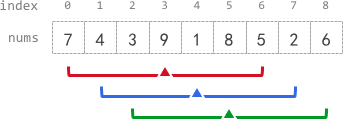
Example 1:
Input: nums = [7,4,3,9,1,8,5,2,6], k = 3 Output: [-1,-1,-1,5,4,4,-1,-1,-1]
Explanation:
avg[0], avg[1], and avg[2] are -1 because there are less than k elements before each index.
The sum of the subarray centered at index 3 with radius 3 is: 7 + 4 + 3 + 9 + 1 + 8 + 5 = 37. Using integer division, avg[3] = 37 / 7 = 5.
For the subarray centered at index 4, avg[4] = (4 + 3 + 9 + 1 + 8 + 5 + 2) / 7 = 4.
For the subarray centered at index 5, avg[5] = (3 + 9 + 1 + 8 + 5 + 2 + 6) / 7 = 4.
avg[6], avg[7], and avg[8] are -1 because there are less than k elements after each index.
Example 2:
Input: nums = [100000], k = 0
Output: [100000]
Explanation:
The sum of the subarray centered at index 0 with radius 0 is: 100000.
avg[0] = 100000 / 1 = 100000.
Example 3:
Input: nums = [8], k = 100000
Output: [-1]
Explanation:
avg[0] is -1 because there are less than k elements before and after index 0.
Approach
Input: An integer array nums and an integer k.
Output: Return an array populated with the k-radius averages centered at index i.
This problem uses the Fixed-length Sliding Window technique.
- The length of the sliding window is
2 * k + 1. - If the window string length evaluates to 0 (i.e.,
k=0), straightly return the baseline array. - If the window frame overlaps array limits naturally, just return populated sequence initialized comprehensively using
[-1] * len(nums). - Mathematically we only have active evaluations valid located uniquely between sequence bounds indexed at
[k, n - k].
Implementation
from typing import List

class Solution:
    def getAverages(self, nums: List[int], k: int) -> List[int]:
        # Formulate mapping structure populated cleanly carrying placeholder evaluation markers uniformly initially
        n = len(nums)
        result = [-1] * n

        # Immediate mapping returning source when parameters natively stipulate null radius properties directly mapped over
        if k == 0:
            return nums

        # Established window dimension bounding values natively encompassing radius bounds symmetrically
        window_size = 2 * k + 1

        # When properties stipulate dimensions eclipsing structural array limits natively, baseline values stand globally
        if window_size > n:
            return result

        # Capture inaugural segment calculations targeting exact parameters satisfying bounding logic
        window_sum = sum(nums[:window_size])

        # Translate baseline evaluations mathematically dropping float properties safely
        result[k] = window_sum // window_size

        # Migrate evaluations iterating across remainder of active boundaries linearly
        for i in range(k + 1, n - k):
            # Trim leading outlier values logically, append successive incoming tail bounds updating pool dynamically
            window_sum = window_sum - nums[i - k - 1] + nums[i + k]
            result[i] = window_sum // window_size

return result/**
* @param {number[]} nums
* @param {number} k
* @return {number[]}
*/
var getAverages = function(nums, k) {
if (k == 0) return nums;
const windowSize = 2 * k + 1;
const ans = new Array(nums.length).fill(-1);
if (windowSize > nums.length) {
return ans;
}
let windowSum = 0;
for (let i = 0; i < windowSize; i++) {
windowSum += nums[i];
}
ans[k] = Math.floor(windowSum / windowSize);
for (let i = k + 1; i < nums.length - k; i++) {
windowSum = windowSum - nums[i - k - 1] + nums[i + k];
ans[i] = Math.floor(windowSum / windowSize);
}
return ans;
};Complexity Analysis
- Time Complexity: O(n)
- Space Complexity: O(n) for the output array
Links
2090. K Radius Subarray Averages (English)2090. 半径为 k 的子数组平均值 (Chinese)