865. Smallest Subtree with all the Deepest Nodes Medium
Given the root of a binary tree, the depth of each node is the shortest distance to the root.
Return a node so that the subtree rooted at that node contains all the deepest nodes in the original tree.
A node is called the deepest if it has the largest depth possible among any node in the entire tree.
The subtree of a node is that node, plus the set of all descendants of that node.
Example 1:
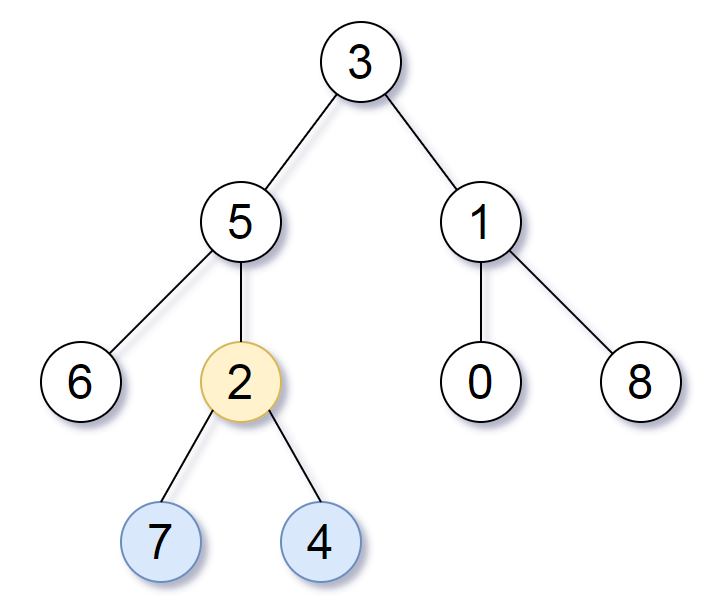
Input: root = [3,5,1,6,2,0,8,null,null,7,4]
Output: [2,7,4]
Explanation:
We return the node with value 2, colored in yellow in the diagram.
The nodes colored in blue are the deepest nodes of the tree.
Notice that nodes 5, 3 and 2 contain the deepest nodes in the tree but node 2 is the smallest subtree among them, so we return it.
Example 2:
Input: root = [1]
Output: [1]
Explanation: The root is the deepest node in the tree.
Example 3:
Input: root = [0,1,3,null,2]
Output: [2]
Explanation: The deepest node in the tree is 2, the valid subtrees are the subtrees of nodes 2, 1 and 0 but the subtree of node 2 is the smallest.
Approach
Input: The root node of a binary tree root.
Output: Return the lowest common ancestor that contains all the deepest nodes
This problem can be solved using either Top-down DFS or Bottom-up DFS.
Top-down DFS
We can maintain two global variables ans and max_depth to record the answer and the maximum depth found.
- As we traverse downwards, we can pass the depth of the next level as an argument, and update the maximum depth at each step during the recursion.
- When evaluating whether the depths of the left and right subtrees are equal AND both reach the global maximum depth, that subtree's root is the answer.
- Since the maximum depth only increases, we will definitely obtain the correct maximum depth for the whole tree after a complete traversal.
Bottom-up DFS
We can view each subtree as a sub-problem. We only need to know:
- The depth of the deepest leaf in this subtree.
- The lowest common ancestor of the deepest leaves in this subtree.
We can analyze the cases as follows:
- Suppose the root node of the subtree is
node, its left subtree's height isleftHeight, and its right subtree's height isrightHeight. - If
leftHeight > rightHeight, then the height of the current subtree isleftHeight + 1, and the LCA is the LCA of the left subtree. - If
leftHeight < rightHeight, then the height of the current subtree isrightHeight + 1, and the LCA is the LCA of the right subtree. - If
leftHeight == rightHeight, then the height of the current subtree isleftHeight + 1, and the LCA is thenodeitself. By contradiction: if the LCA is in the left subtree, it would not be an ancestor of the deepest leaf nodes in the right subtree, which is incorrect; if the LCA is in the right subtree, it wouldn't be an ancestor of the left subtree's leaves either; if the LCA is somewhere abovenode, then it wouldn't meet the "lowest" (smallest subtree) requirement. Thus, the LCA must benode.
Implementation
Top-down DFS
class Solution:
    def subtreeWithAllDeepest(self, root: Optional[TreeNode]) -> Optional[TreeNode]:
        # Record the maximum depth
        max_depth = 0
        # Lowest common subtree root node
        ans = None

        def dfs(node, depth):
            nonlocal max_depth, ans

            if not node:
                # Update global maximum depth
                max_depth = max(max_depth, depth)
                return depth  # Empty node returns the current depth for comparison

            # Calculate the maximum depth of the left and right subtrees respectively
            left = dfs(node.left, depth + 1)
            right = dfs(node.right, depth + 1)

            # If both the left and right subtrees of the current node reach the maximum depth
            if left == right == max_depth:
                ans = node  # The current node is the root of the smallest subtree containing all the deepest nodes

            # Return the depth of the deeper subtree
            return max(left, right)

        dfs(root, 0)
return ans/**
* @param {TreeNode} root
* @return {TreeNode}
*/
var subtreeWithAllDeepest = function(root) {
let ans = null;
let maxDepth = 0;
function dfs(node, depth) {
if (!node) {
maxDepth = Math.max(maxDepth, depth);
return depth;
}
const left = dfs(node.left, depth + 1);
const right = dfs(node.right, depth + 1);
if (left == right && left == maxDepth)
ans = node
return Math.max(left, right);
}
dfs(root, 0);
return ans;
};Bottom-up DFS
class Solution:
    def subtreeWithAllDeepest(self, root: Optional[TreeNode]) -> Optional[TreeNode]:
        # Bottom-up DFS
        # Define a bottom-up DFS function, returning (max depth of subtree, LCA of deepest nodes)
        def dfs(node):
            if not node:
                # Assuming empty node has depth 0, and no LCA
                return 0, None

            # Recursively process left and right subtrees to get their max depth and corresponding LCA
            left_depth, left_lca = dfs(node.left)
            right_depth, right_lca = dfs(node.right)

            # Determine based on heights of left and right subtrees:
            if left_depth > right_depth:
                # Left subtree is deeper, return left subtree's info, and increment depth by 1
                return left_depth + 1, left_lca
            elif right_depth > left_depth:
                # Right subtree is deeper, return right subtree's info, and increment depth by 1
                return right_depth + 1, right_lca
            else:
                # Heights are equal, the current node is the lowest common ancestor of the deepest nodes
                return left_depth + 1, node

        # Return the final lowest common ancestor node
return dfs(root)[1]/**
* @param {TreeNode} root
* @return {TreeNode}
*/
var subtreeWithAllDeepest = function(root) {
// Bottom-up DFS
function dfs(node) {
if (!node) return [0, null];
const [leftDepth, leftLca] = dfs(node.left);
const [rightDepth, rightLca] = dfs(node.right);
if (leftDepth < rightDepth)
return [rightDepth + 1, rightLca];
if (leftDepth > rightDepth)
return [leftDepth + 1, leftLca];
return [leftDepth + 1, node];
}
return dfs(root)[1];
}Complexity Analysis
- Time Complexity:
O(n) - Space Complexity:
O(n)